 |
 |

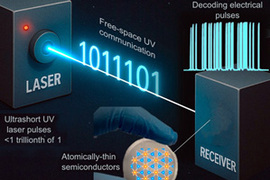
Nottingham and Imperial team say approach has applications in optical wireless, materials processing, and imaging.

Low-coherence holotomography and nanowire substrate allow study of cells in their natural state.

Supervisory Board thanks him for past 9 years’ leadership; will now search for his successor.
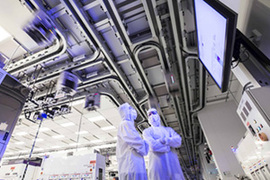
Company says it is now world’s largest pure-play silicon photonics foundry.
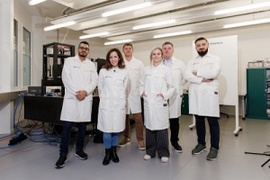
Pre-seed investment round to fund expansion of Neuchâtel laboratory.
…and Oxford discovers way to switch OLEDs to emit polarized light without altering light-emitters.
 26 Nov 25 |
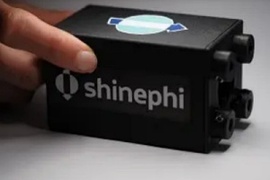
ICFO spin-out Shinephi completes €1M seed fund Startup's mission is to provide advanced optical metrology based on interferometric phase imaging. |
 25 Nov 25 |
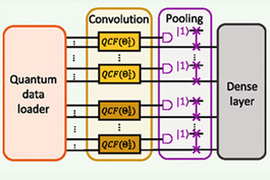
Rome-led group progresses toward practical photonic quantum neural networks ‘Simple adaptive method’ makes optical quantum processors behave like neural networks. |
 25 Nov 25 |
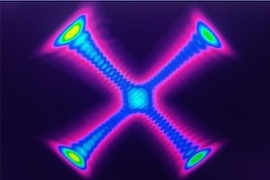
Tampere University develops optical vortex beams as enabling technology... ...and Paul Scherrer Institute launches technology transfer center for assembly of optical components. |
 25 Nov 25 |
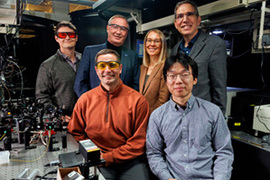
Purdue’s single-photon switch promises ‘terahertz-speed’ photonic computing... ...and KAIST’s efficient quantum process tomography enables scalable optical quantum computing. |
 25 Nov 25 |
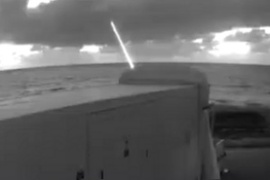
MBDA signs £316M deal to supply UK's Royal Navy with laser weapons 'DragonFire' systems now set to be delivered from 2027, targeting high-speed drones. |
 24 Nov 25 |
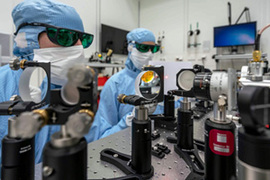
German group to work to improve lasers with quantum computers Trumpf, Fraunhofer ILT, and FU Berlin developing quantum algorithms to boost laser efficiency. |
Hamamatsu Photonics Europe GmbH

Master Bond Inc.

Resolve Optics Ltd

Oxford Instruments Andor
 | Harnessing Einstein’s Photoelectric Effect: Advancements in LiDAR Technology and Its Impact on Modern Sensors 26 Aug Hamamatsu Photonics Europe Hamamatsu Photonics is leading the evolution of LiDAR with advanced sensor technologies that enhance precision and reliability. Their Time-of-Flight systems, based on Einstein’s photoelectric effect, use rapid laser pulses and sophisticated detectors - Avalanche Photodiodes (APDs) and Silicon Photomultipliers (SiPMs) - to capture real-time distance data with exceptional accuracy. Optimized for thermal stability and energy efficiency, these sensors are ideal for autonomous vehicles, robotics, and smart devices. Hamamatsu’s continued innovation in APD and SiPM technologies is accelerating the integration of intelligent systems into everyday life. |
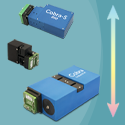 | Choosing the best spectrometer for NIR OCT 02 Apr Wasatch Photonics Near infrared optical coherence tomography has traditionally been limited to imaging depths of just a few millimeters, but with our expanded line of OCT spectrometers, up to 12 mm is possible. In this tech note, we explore and compare three different drop-in spectrometer models designed to serve a wide range of resolution, depth, and size requirements in NIR OCT imaging. |
 | Identifying Optical Materials with Precision Accuracy 04 Mar Knight Optical Precision accuracy is a critical necessity with any optical component. Rigorous testing to ensure strict compliance with given requirements will always be essential; it is a vitally important demand within any industry sector. Dimensional, surface profiling and optical performance testing are significant aspects of this process, but an additional layer of assurance and quality can be achieved with the use of material verification, employing methods such as refractive index, density testing and transmission measurement. This White Paper explores advanced techniques for precise optical material verification, overcoming the limitations of traditional testing methods. |
 | Surface Quality Control for Maximizing LIDT in High-PowerLaserOptics 06 Oct Optoman in collaboration with Dioptic In high-power laser systems, the optical components' resilience to laser-induced damage directly determines performance, reliability, and service life. Even minor surface or subsurface imperfections can severely compromise the laser-induced damage threshold (LIDT), introducing failure points that limit system capability. |












 |
| © 2025 SPIE Europe |
|